Family Building for Trans and Non-Binary Parents: An Affirming, Honest Guide

Trans and non-binary people build families, full stop. And yet this community is too often left out of the fertility conversation entirely, or handed care that was clearly not designed with them in mind. We want to do better than that here. This is an affirming, honest guide to the paths, the considerations, and how to find care that actually sees you.
The paths are real and varied
Trans and non-binary people build families through many routes, depending on their bodies, their transition history, their partners, and their goals: using their own gametes (eggs or sperm) where possible, donor eggs or sperm, IUI or IVF, gestational surrogacy, and adoption or embryo donation. There is no single "trans family-building path," because there is no single trans experience. The right route is yours to define with good medical guidance.
Fertility preservation matters, and timing matters
One of the most important and time-sensitive considerations is fertility preservation. Because some gender-affirming medical care can affect fertility, many trans and non-binary people choose to preserve eggs or sperm before starting certain treatments. This is a deeply personal decision, and not everyone will want or be able to do it, but it is one that benefits enormously from clear, early, non-judgmental information. The mistake we want to help people avoid is not knowing it was an option until the window had narrowed.
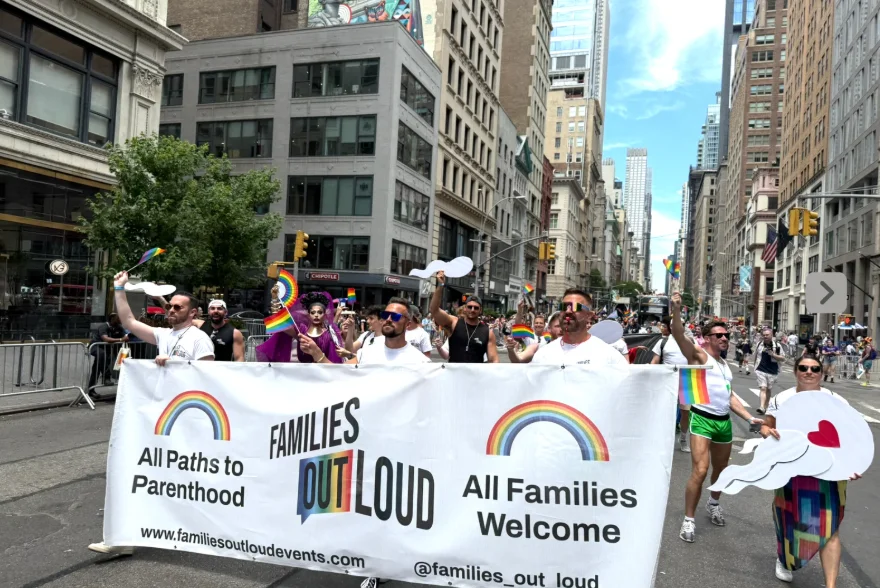
Families Out Loud brings honest, jargon-free family-building education to six cities in 2026 — with the experts in the room to answer your questions. One $40 weekend ticket.
The care gap, named honestly
Trans and non-binary patients frequently encounter fertility care that ranges from awkward to actively alienating: forms that misgender them, staff who have never worked with a trans patient, and clinical language built entirely around cisgender, heterosexual assumptions. The structural exclusion shows up in coverage too, where definitions of infertility built around cisgender heterosexual couples leave trans and non-binary people out by design. (Bloomberg Law) None of this reflects anything about your worthiness to be a parent. It reflects a system that has not caught up.
How to find care that sees you
After many conversations with trans and non-binary parents and hopeful parents, here is what we have learned to look for: providers who use your correct name and pronouns without being asked twice, intake processes that do not force you into the wrong boxes, clinicians experienced with fertility preservation in the context of gender-affirming care, and agencies and programs that treat your family as the point rather than a teaching case.
This is exactly the kind of inclusivity we screen for before any provider enters a Families Out Loud room. Inclusive is one of our five core principles, and we mean it specifically, not as a slogan. Every family, every route includes trans and non-binary parents, and the providers we partner with are vetted against ASRM and SEEDS ethics standards and chosen, in part, for how they actually treat the people in front of them.
You belong here
If you have felt invisible in fertility spaces, we want Families Out Loud to be the opposite of that experience: a room where you are seen, your questions are normal, and the providers were chosen partly because they will get your name right. Building your family is your right, and you deserve information and care that affirm that from the first conversation.
Sources
Families Out Loud is a nonprofit family-building community and traveling conference, founded by Mike Snaric and George Moore out of their own family-building journey. We make the path to parenthood safer, clearer, and more humane.